IROS 2025IEEE/RSJ International Conference on Intelligent Robots and Systems, Hangzhou
FalconGym

FalconGym: A Photorealistic Simulation Framework for Zero-Shot Sim-to-Real Vision-Based Quadrotor Navigation

Yan Miao, Will Shen, Sayan Mitra

University of Illinois Urbana-Champaign

A visual policy trained only in a NeRF twin flies a real quadrotor through 120 gates with no fine-tuning.

Quadrotor
Platform

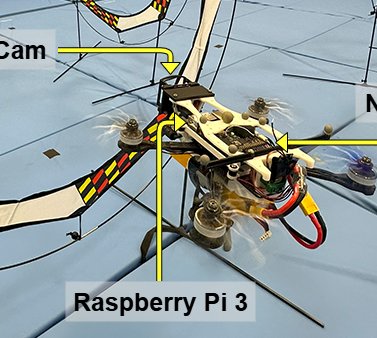
Quadrotor

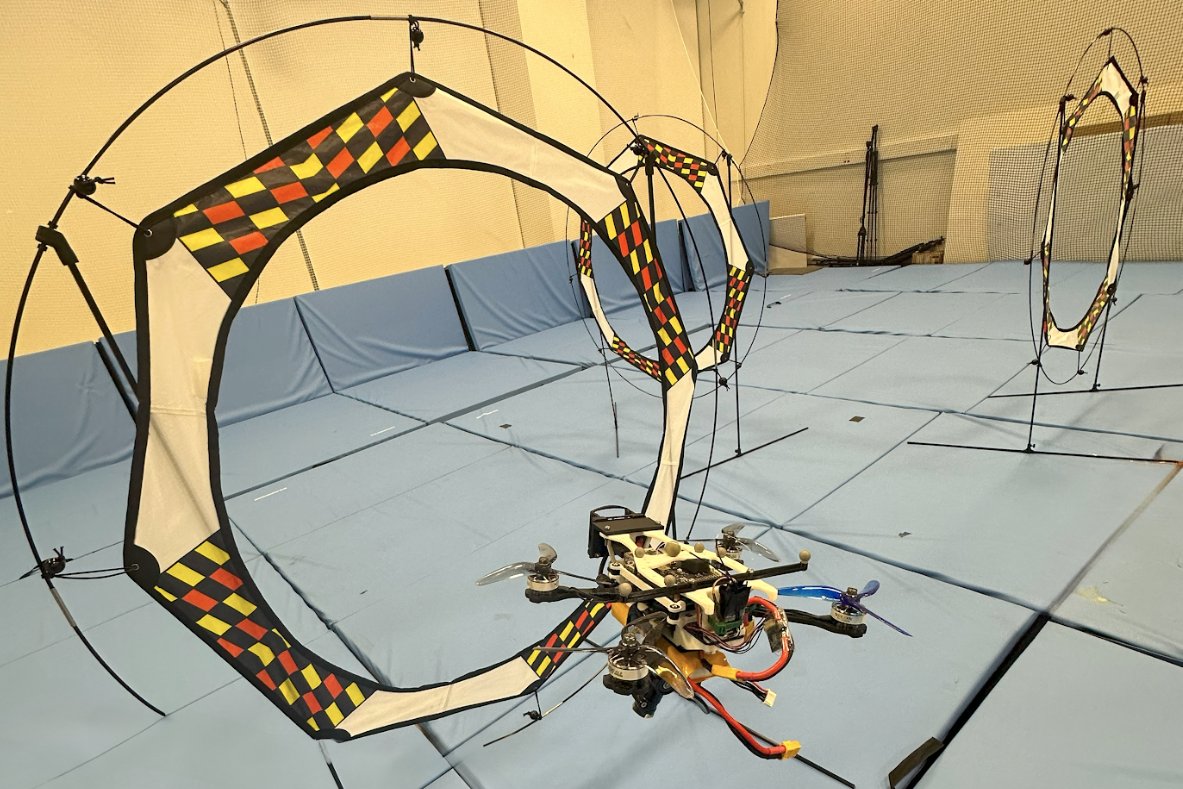
ArduCam RGB camera, Navio2 IMU, Raspberry Pi 3. 38 cm-radius racing gates.

95.8%success over 120 real gates in 30 hardware flights
10 cmmean gate-crossing error on 38 cm-radius gates
3tracks: circle, U-turn, figure-8, one policy each

Abstract

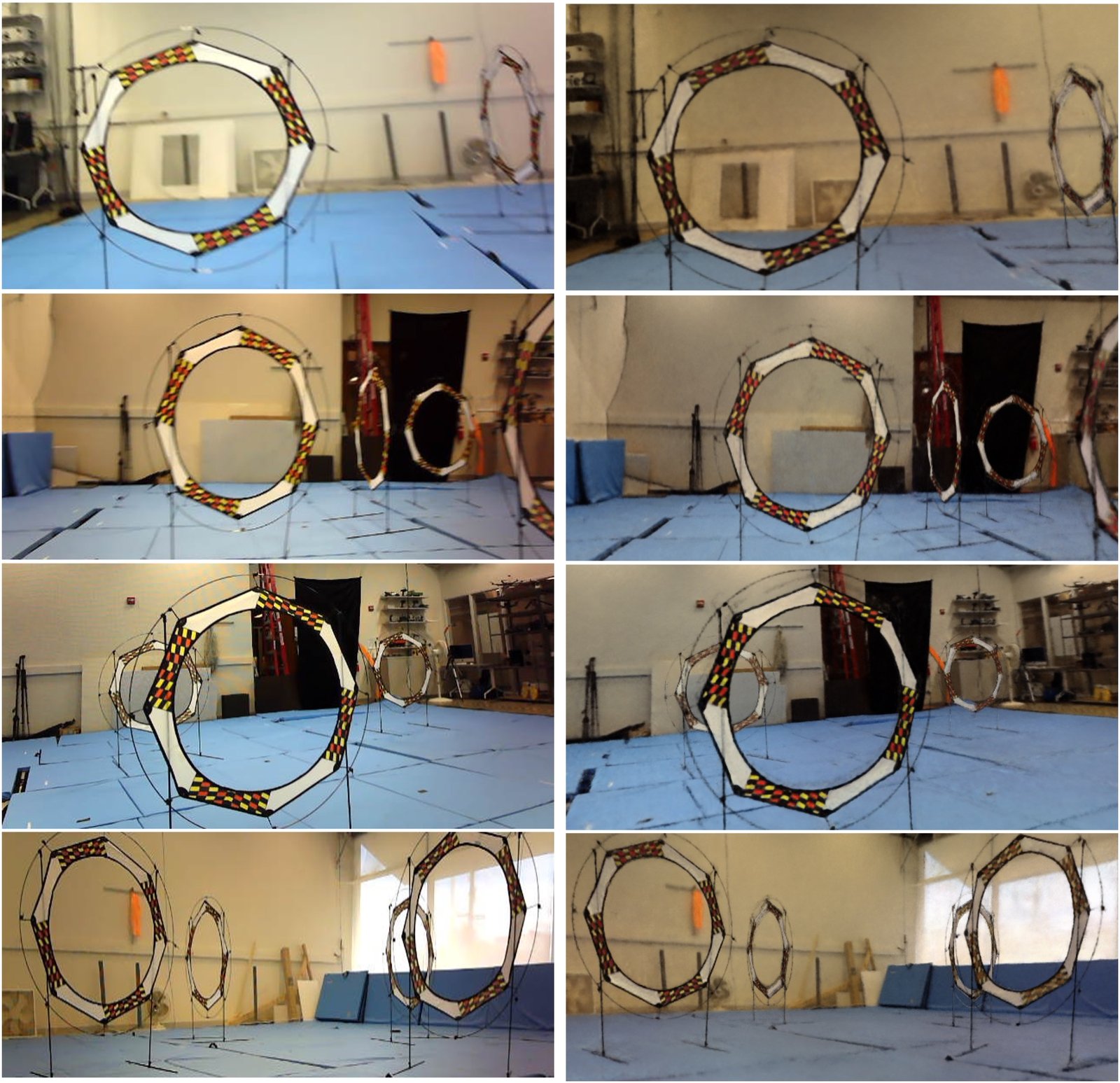
We present a novel framework demonstrating zero-shot sim-to-real transfer of visual control policies learned in a Neural Radiance Field (NeRF) environment for quadrotors to fly through racing gates. Robust transfer from simulation to real flight poses a major challenge, as standard simulators often lack sufficient visual fidelity. To address this, we construct a photorealistic simulation environment of quadrotor racing tracks, called FalconGym, which provides effectively unlimited synthetic images for training.

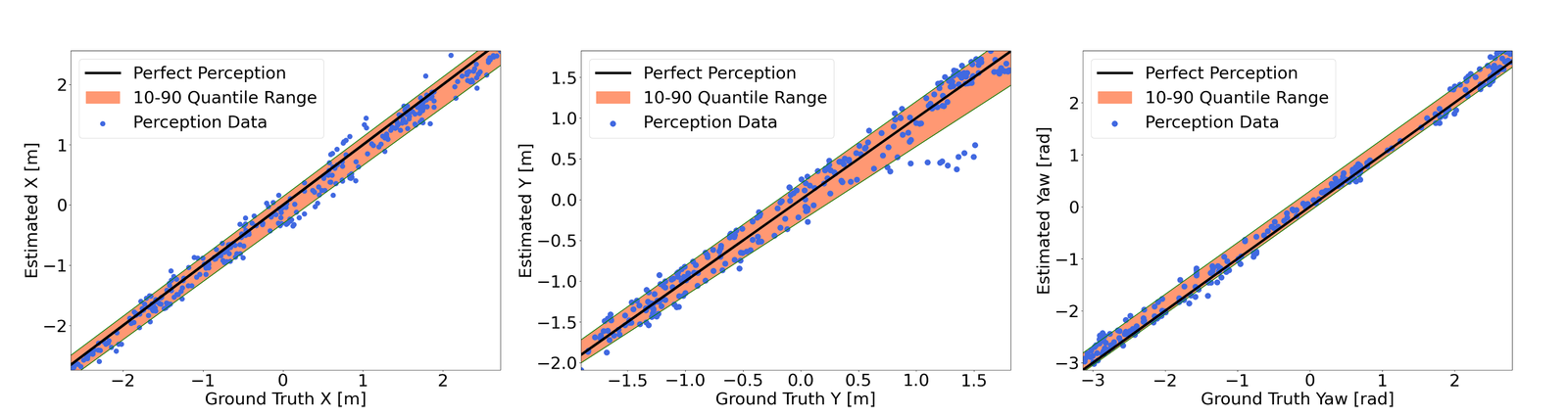
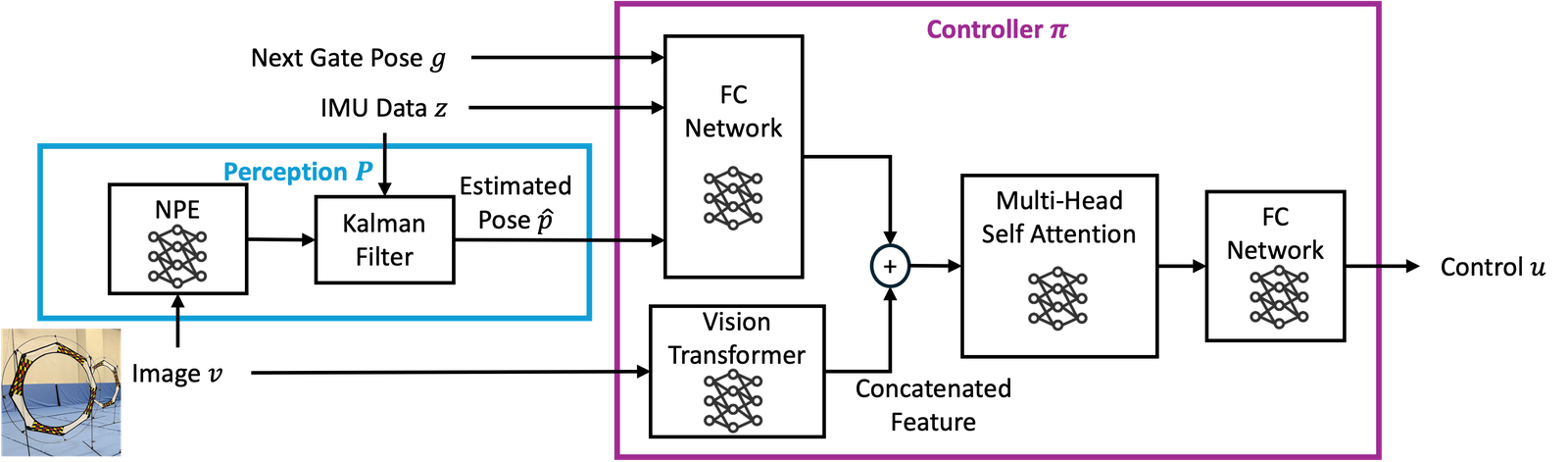
Within FalconGym, we develop a pipelined approach for crossing gates that combines (i) a Neural Pose Estimator (NPE) coupled with a Kalman filter to reliably infer quadrotor poses from single-frame RGB images and IMU data, and (ii) a self-attention-based multi-modal controller that adaptively integrates visual features and pose estimation. This multi-modal design compensates for perception noise and intermittent gate visibility. We train this controller purely in FalconGym with imitation learning and deploy the resulting policy to real hardware with no additional fine-tuning.

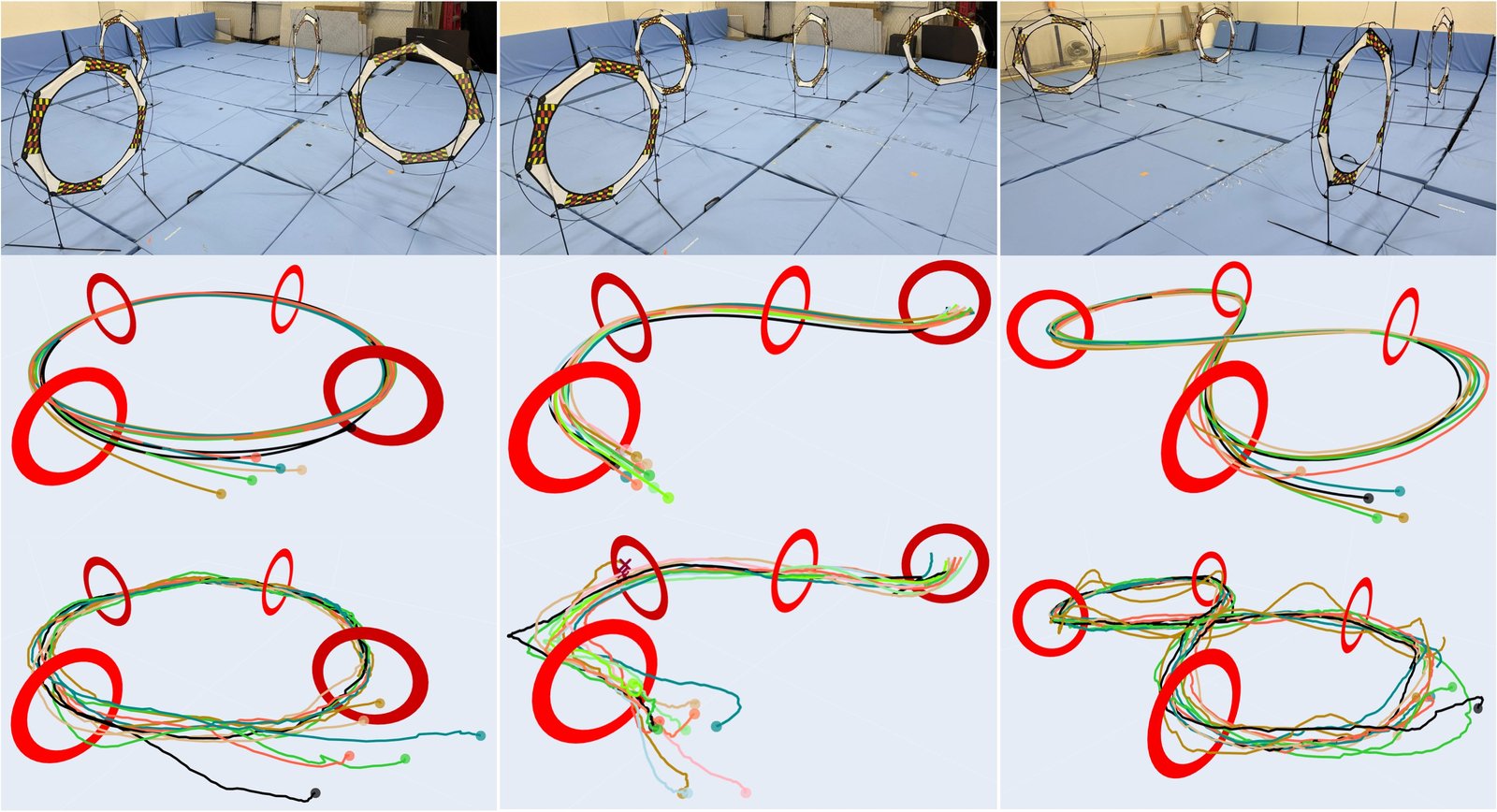
Simulation experiments on three distinct tracks (circle, U-turn and figure-8) demonstrate that our controller outperforms a vision-only state-of-the-art baseline in both success rate and gate-crossing accuracy. In 30 live hardware flights spanning three tracks and 120 gates, our controller achieves a 95.8% success rate and an average error of just 10 cm when flying through 38 cm-radius gates.
Method

Closed-loop architecture: NeRF-rendered observations drive the perception and control stack that transfers zero-shot to hardware.

Closed-loop architecture: NeRF-rendered observations drive the perception and control stack that transfers zero-shot to hardware.

Neural Pose Estimator + Kalman filter infers quadrotor pose from single-frame RGB and IMU.

Neural Pose Estimator + Kalman filter infers quadrotor pose from single-frame RGB and IMU.

Results

Real camera frame vs. FalconGym NeRF render of the same arena: the photorealism that makes zero-shot transfer work.
The real flight arena: quadrotor and racing gates used in 30 live hardware flights.
Flight trajectories across circle, U-turn, and figure-8 tracks.

BibTeX

@inproceedings{miao2025falcongym,
  author    = {Yan Miao and Will Shen and Sayan Mitra},
  title     = {FalconGym: A Photorealistic Simulation Framework for Zero-Shot Sim-to-Real Vision-Based Quadrotor Navigation},
  booktitle = {IEEE/RSJ International Conference on Intelligent Robots and Systems (IROS)},
  year      = {2025},
  address   = {Hangzhou, China},
  month     = {October},
}